
Understanding maternal
mortality in Kenya.
A national survey reviewing maternal deaths in health facilities across all 47 counties — to produce corrected maternal mortality ratios for 2023–2025 and reveal how many deaths routine systems miss.
What's the true number of maternal deaths in Kenya?
Maternal deaths are documented unevenly across Kenyan facilities. The extent of under- and over-reporting in routine data is itself unknown — which is exactly what this survey sets out to measure.
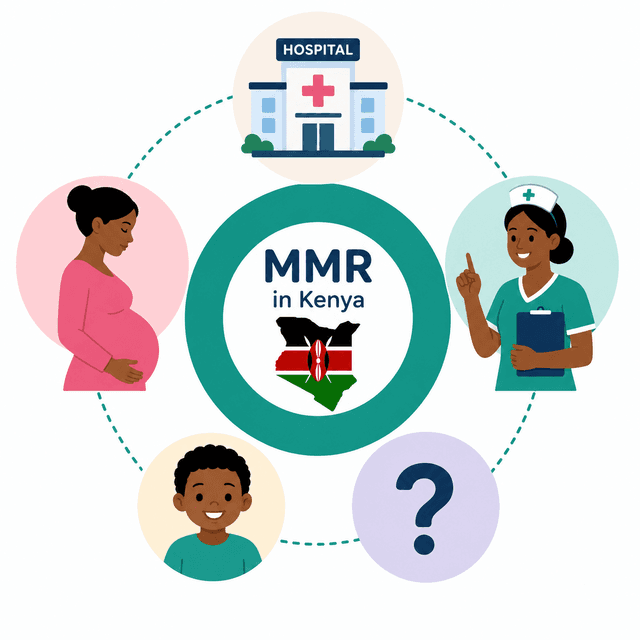
Maternal mortality ratio
What is MMR, and why does it matter?
The MMR counts maternal deaths per 100,000 live births — women who die during pregnancy or within 42 days of delivery from causes related to, or made worse by, the pregnancy. It is a core measure of how well a health system protects mothers.
Despite real gains in skilled maternity care, Kenya's MMR stays high — and the true figure is uncertain, because routine systems systematically miss, misclassify and underreport deaths. RAMOS exists to close that gap.
The death of a woman while pregnant or within 42 days of termination of pregnancy — from any cause related to or aggravated by the pregnancy or its management, but not from accidental or incidental causes.
The number of women who die from pregnancy-related causes while pregnant or within 42 days of termination of pregnancy, per 100,000 live births.
Where RAMOS collects its data.
RAMOS covers all level 4–6 hospitals and a sample of selected lower-level facilities (levels 2 and 3) across Kenya's 47 counties, verified against the Kenya Master Facility List.
From facility records to national insight..
Bringing together data from every county to build a fuller, more trustworthy picture of maternal health in Kenya.
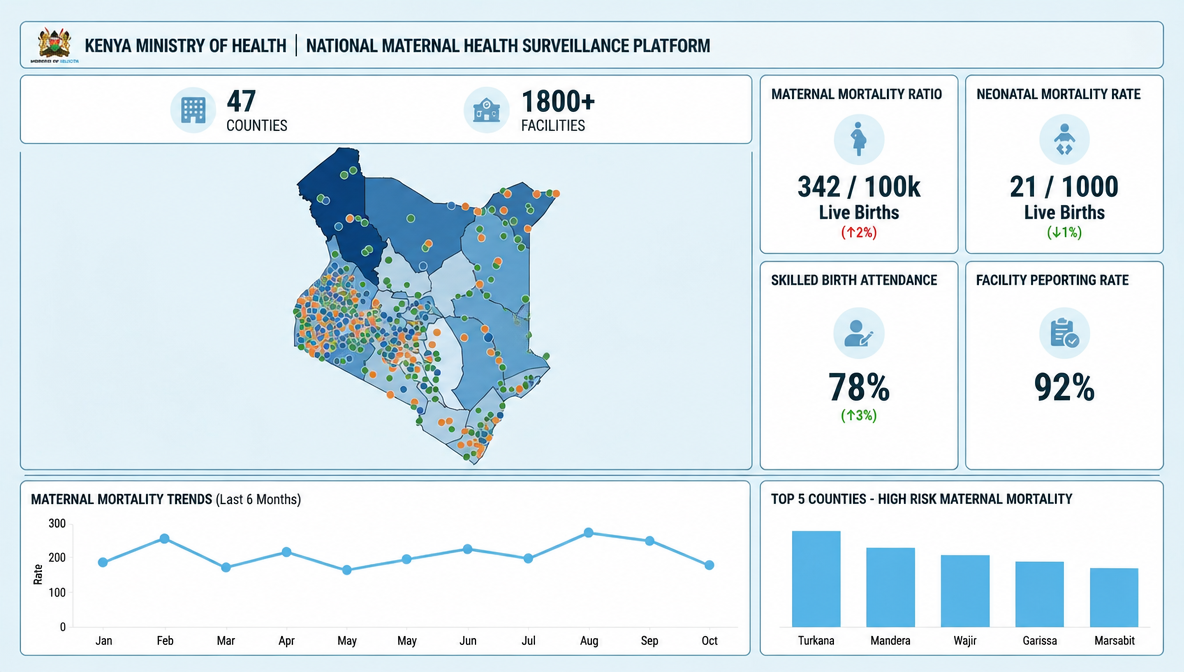
Why Kenya needs a better count.
RAMOS exists to generate valid, reliable data on the national status of maternal mortality — so policy rests on evidence, not estimates.
Maternal deaths are frequently missed, misclassified or underreported in routine systems — KHIS, MPDSR and civil registration — leaving policymakers without reliable data.
A retrospective, mixed-methods survey reviewing deaths of women aged 10–49 across all 47 counties, using facility registers, patient records, MPDSR files and KHIS reports.
Corrected national and county-level maternal mortality ratios for 2023–2025 — identifying the leading causes of death and measuring how much routine data under- or over-reports.
Maternal deaths are a signal that something failed during pregnancy or childbirth. Kenya has invested heavily in skilled maternity care, yet maternal mortality stays high — and the real figure is uncertain, because each routine system misses or misclassifies deaths in its own way. By reconciling facility records against these sources, RAMOS builds a more complete and trustworthy picture to guide policy, funding and programme design.
Kenya's national MMR remains high and is off track for SDG target 3.1 — partly a real gap, partly a reporting one. RAMOS is built to tell them apart.
The survey will identify the leading direct and indirect causes of maternal death — detail that routine reporting rarely captures reliably today.